
“Grisaille (/ɡrᵻˈzaɪ/ or /ɡrᵻˈzeɪl/; French: gris [ɡʁizaj] ‘grey’) is a term for a painting executed entirely in shades of grey or of another neutral greyish colour… A grisaille may be executed for its own sake, [or] as underpainting … working in grisaille was often chosen as being quicker and cheaper, although the effect was sometimes deliberately chosen for aesthetic reasons. Grisaille paintings resemble the drawings, normally in monochrome, that artists from the Renaissance on were trained to produce.” WIKIPEDIA


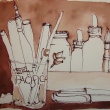
Examples of grisaille underpainting above.
In all these paintings watercolors were eventually applied over the grey ink.
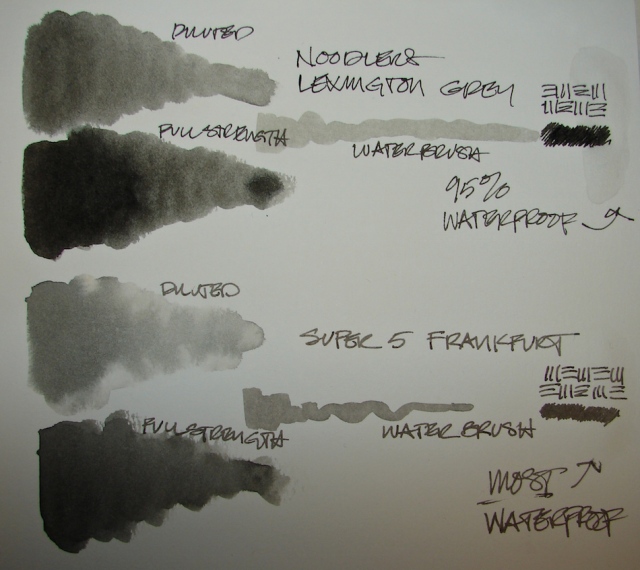
 For grisaille I want a neutral grey that is truly waterproof. To date there has been only
one that I really liked, and that is Noodler’s Lexington Grey.
*btw, i’ve sent you to the large size with the inkdropper + free pen*
All that has changed! (My tests above.)
 A friend from Europe has been painting with this yummy grey.
Super5 is my favorite brand, and the grey is Super5 Frankfurt ink.
Understand that is is selling on Amazon right now as a BROWN — NOT!
*those of you in Europe and AU can buy Super5 easily, not so in the states*
Update: You can also get it at Blue Rooster!
It has a superfine granulation (as opposed to Lexington, above it) and
is a gorgeous warm grey. Unlike Lexington (and Noodler’s waterproof inks in general)
it does not bleed at all on any paper I’ve tried it on, whereas, as you can see from the waterwash over the pen ink marks, the Lex will bleed slightly on many papers.
The Lexington Grey bleed is not enough to stop me from using it MOST times,
but I always test it at the back of any new journal.
UPDATE: Now I paint a lot with many inks and like the effect of both!
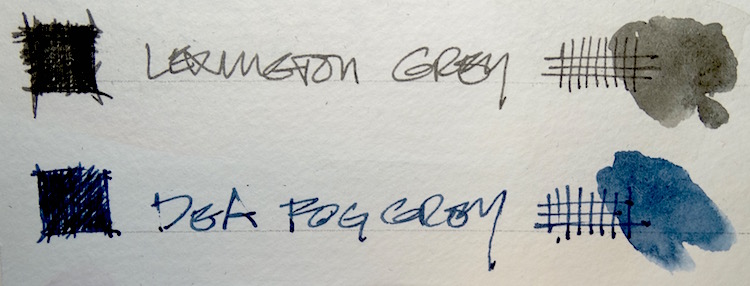 I’ve come a long way from an earlier article on favorite inks especially in terms of how I use them. Now I paint with them like crazy, and buy sample sizes from Goulet on a regular basis. Because I love De Atramentis inks I want to comment about their
Document Fog Grey ink, above. It is simply too blue to be called a grey.
Look at it compared to their Document Blue.
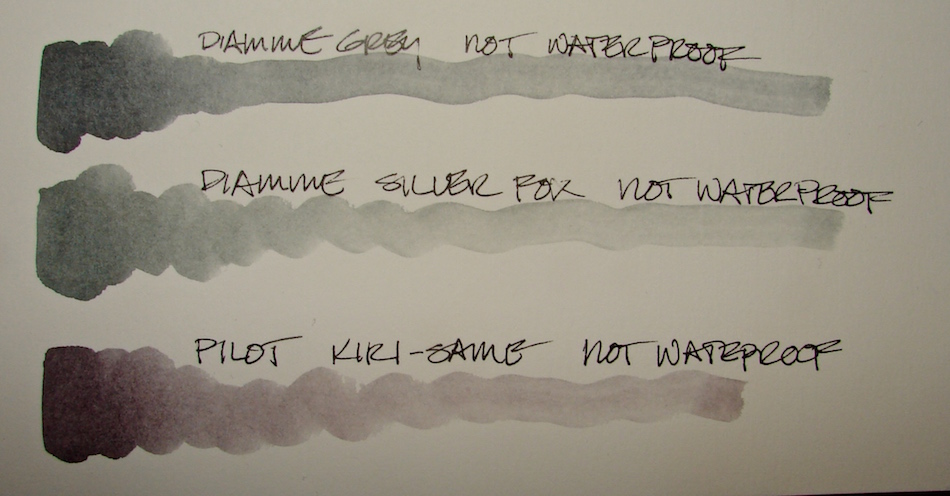 I have a confession to make. I love buying ink samples from Goulet, but lately I’ve bought the same three over and over (duh!) exploring non-waterproof gorgeous grey inks.
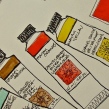
These are the three I’ve purchased in tiny ink samples.
I doubt I will buy them full size.
The Diamine inks, while pretty, are not interesting enough considering they are not waterproof. And I can mix Pilot tone with Super5 Frankfurt and Australia mixed…
UPDATE: I bought the Diamine Grey… I love it and play with it as
I now paint with many inks, not just waterproof inks. Sketchbook only though,
as only two inks I know of are tested for lightfastness, De Atramentis and Super5.
☾
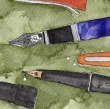
Strathmore journal. Pilot Preppy pen with Noodler’s Lexington Grey Ink,
Pilot Preppy pen with Super5 Frankfurt (Amazon or from Blue Rooster.
Diamine Grey, Diamine Silver Fox, Pilot Kiri-Same sample sizes from Goulet.

©D. Katie Powell.
My images/blog posts may be reposted; please link back to dkatiepowellart.
☾
 As my Patreon supporter, you will have
access to some content not on this website,
sneak previews, goodies, discounts on classes.
I teach architectural sketching,
art journaling (art+writing), creativity, watercolors.
That annoying loud-mouth editor/critic in your head? GONE! How great would that be?















 I don’t sketch with brush pens often,

























 D.Katie Powell Art
Motherwell, Must Read
Liz Doyle offered this interview by Motherwell, and whether it came at the right time as I turn back into myself for my work, or if it is just brilliant I don’t know… but I’ve read it several times, and it keeps coming up for me as I lead groups where people are
not happy with their work, where they compare themselves to the millions of great
paint technicians out there, where they don’t trust their scribbles and their mistakes.
A sample below, of the passages that keep whirling for me.
An Interview with Robert Motherwell by Barbara Flug Colin
*edited excerpt… must read!*
Robert Motherwell: … Stanley Kunitz, the Pulitzer Prize poet, [said] there are more good poets now than there ever were … But among the younger ones there are no masters, there are no outstanding ones… I have very much the same take. The level of competency in the arts is infinitely higher than it was fifteen years ago, but it is almost never that you come across a powerful personality, in the sense of a Pollock, or I don’t know… a Francis Bacon… or whatever.
Barbara Flug Colin: Is it something about our present culture?
Robert Motherwell: I think it is partly because everybody is now so well taught. The United States is the only place in the world where major universities have numerous courses in “Twentieth Century Art History,” and also actual studio practice. I mean Heidelberg or Oxford or the Sorbonne would drop dead at the idea. And since the war, our universities have increasingly absorbed very good painters … The only way [an artist] can make a living is by lecturing in the universities; in that sense, I don’t suppose there has even been, in the last 150 years, a system set up where some of the best practitioners of the various arts are directly addressing thousands of students of those arts, and that is bound to make some students more sophisticated. But at the same time, they are being spoon-fed what earlier artists had to seek out, in any nook or cranny, because it didn’t exist to be presented to you.
Barbara Flug Colin: What I am hearing you say has to do with an earning of the self.
Robert Motherwell: Exactly. There is so much … superbly educated skill. But there is very little confrontation with selfhood . . . I think it also has to do with a lack of innocence, a lack of belief in civilization that people born early in the century still have. Kunitz has it. I have it. It is marvelous to discover this stuff and make it your own, to be a part of it.
… In a sense, education, in the broadest sense, is to socialize people. Most people want to be socialized, and are embarrassed at not knowing the conventions. So not only is the teacher teaching conventions, the student really wants to learn the conventions, and to be one of the boys. And it is obvious that, if there are many types of human characters, the convention becomes artificial basically for the majority of them, even if it is necessary socially. But I would think one of the functions of modern art is to break through conventions to what is the ultimate truth of a given person’s beingness.
Art is not made by one of the boyz.
Art comes from your soul’s expression, and for that to happen,
YOU HAVE TO TRUST YOUR SOUL.
Make your marks, play, have a doodle, experiment, see where it takes you.
Don’t compare yourself to the next guy, because the next guy might just want to be technically correct, and that means you end up a good draughtswoman.
Nothing wrong with a wanting to be a good draughtswoman,
just understand that MOST renderings are not art, but pretty pictures.
*Nothing wrong with pretty pictures; I love to look at them. They rarely move me.*
Two years ago, for the first time, I steeped myself in learning technique as a shortcut
with watercolor. My editor soon became in charge of my paintbrush.
When I first wanted to paint, over breakfast at the West Beach Cafe I asked
Billy Al Bengston whether I should go back to school for a MFA. He said, “Do you want to paint or teach?” and advised me to take the money I’d spend on college and take the
time off and buy cheap paint and canvas and go to it. I took his advice at 29.
Now at 60 it is time to unlearn and go back to my own screwy sense of whatever I want to play with and not think about being technically correct. It took me two years to undo what technical drawing did to me as a artist. Let’s hope this time I remember the path. Its not throwing the baby out with the bathwater, just taking the baby for a spin in the mud.
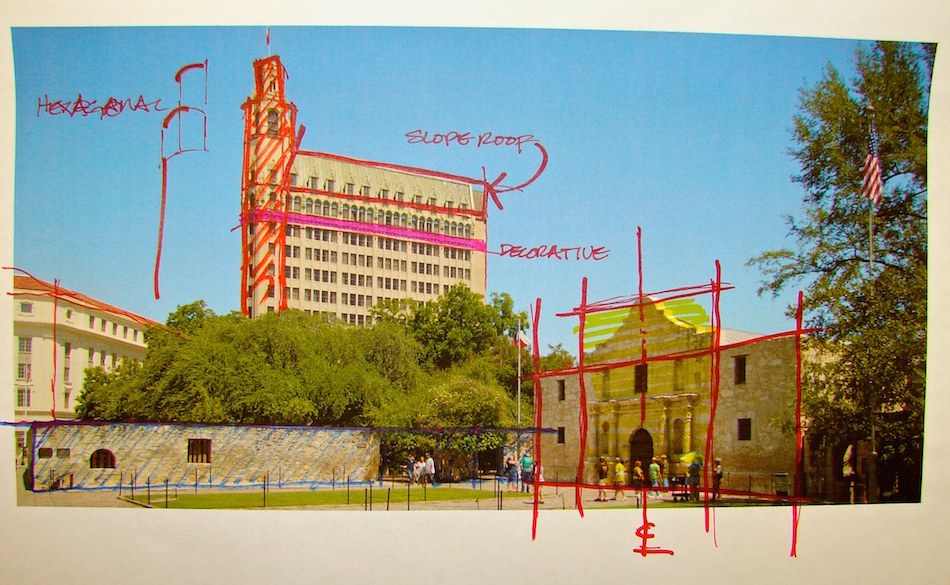
Who do I look at, when it comes to Urban Sketchers?
Kiah Kiean Ch’ng
Jose Maria Lerdo de Tejada
reuven DATTNER
Pat Southern-Pearce (below)
Marc Taro Holmes
I agree to Creative Commons Attribution-Non-Commercial 4.0 International License, which you can learn more about by visiting the site, or,
visit my web page for a more user-friendly summary on my terms.
My images/blog posts may be reposted; please link back to dkatiepowellart.
I'd love it if you shared this; please mention my blog name!